 Mint blockchain
Mint blockchain exits depend on eligibility, timing and proof of Ethereum delivery
- updated
Mint blockchain ceased general operations on April 17, 2026, leaving a limited withdrawal process for eligible balances to Ethereum before October 20, 2026. The withdrawal service lists ETH, WBTC, USDC and USDT, processes weekly batches and says assets typically arrive within 10 days. Eligibility alone does not prove completion. Confirm the connected wallet and asset before submission, preserve the evidence displayed for the request and then verify the delivered transaction and balance on Ethereum. If the asset is absent, the connected wallet cannot be confirmed or the request remains unresolved beyond the expected window, stop and preserve the evidence rather than create repeated requests.
In short: Eligible balances need a confirmed receiving address, enough processing time and onchain delivery evidence before the October 20, 2026 cutoff.
Portal Withdrawal and Unresolved Requests
The standard portal path begins with the wallet that holds an eligible balance. Connect that wallet, confirm that the service recognizes the asset and review every displayed withdrawal detail. Nothing should be submitted while the asset, amount or connected wallet remains unclear.
Before submission, leaving the process does not authorize an asset movement. Submission is the commitment boundary because the public withdrawal page does not describe a cancellation or editing mechanism. Resolve the asset, amount and connected wallet before submitting.
Mint blockchain ceased operations on April 17, 2026. Its former NFT activity and routine Layer 2 use are therefore separate from the limited exit process that remains. A historical balance or transaction does not establish that the current service will accept the asset.
When the portal omits an expected asset, presents inconsistent details or leaves a request unresolved, stop before creating another request. Save the connected address, selected asset, amount, time and every status or error that the interface displays. Those records give the service contact a defined case to investigate without turning an uncertain state into multiple submissions.
Which Exit Conditions Change the Outcome?
The outcome depends on whether the balance is a listed asset and whether its withdrawal reaches Ethereum before the cutoff. The published withdrawal service lists ETH, WBTC, USDC and USDT. It does not present every Mint balance or NFT record as an eligible exit.
| Position on Mint | Published Exit Outcome | Control After the Outcome |
|---|---|---|
| ETH balance | Eligible for withdrawal to Ethereum | The recipient address holds delivered ETH, and later control follows that address’s signing or contract rules |
| WBTC balance | Eligible for withdrawal to Ethereum | The recipient address holds WBTC, subject to its key arrangement and token contract |
| USDC balance | Eligible for withdrawal to Ethereum | The recipient address holds USDC, subject to its key arrangement and token contract |
| USDT balance | Eligible for withdrawal to Ethereum | The recipient address holds USDT, subject to its key arrangement and token contract |
| Another fungible token | No route for it is listed by the public withdrawal service | The portal provides no published Ethereum delivery outcome for that balance |
| NFT ownership record | The withdrawal service does not list NFTs as transferable assets | The portal provides no listed route for an Ethereum NFT custody change |
| No completed exit by the cutoff | The published warning says remaining assets will be unavailable for processing | No new Ethereum position is established through the withdrawal service |
| Supported result | A completed exit moves one of four named assets to Ethereum | Delivery evidence identifies the recipient address; later control follows that address’s signing or contract rules |
A token symbol alone does not prove contract identity because unrelated contracts can reuse the same symbol. Read the Ethereum transaction, token contract and transfer record together. This check matters most for WBTC, USDC and USDT because each delivered balance is represented by a token contract rather than Ethereum’s native asset.
Evidence That Survives the Move
Completion evidence must connect the Mint-side request with an Ethereum-side result. The retired network was an OP Stack Layer 2, while the remaining service delivers eligible balances to Ethereum through scheduled processing. A record on Mint can establish the starting position, but it does not prove that Ethereum received the asset.
Preserve the information that separates a submitted request from a completed transfer:
- The connected Mint wallet address and selected asset
- The requested amount and submission time
- Any request identifier, status message or error shown by the interface
- The Ethereum transaction hash and successful receipt when available
- The recipient address, transferred amount and resulting Ethereum balance
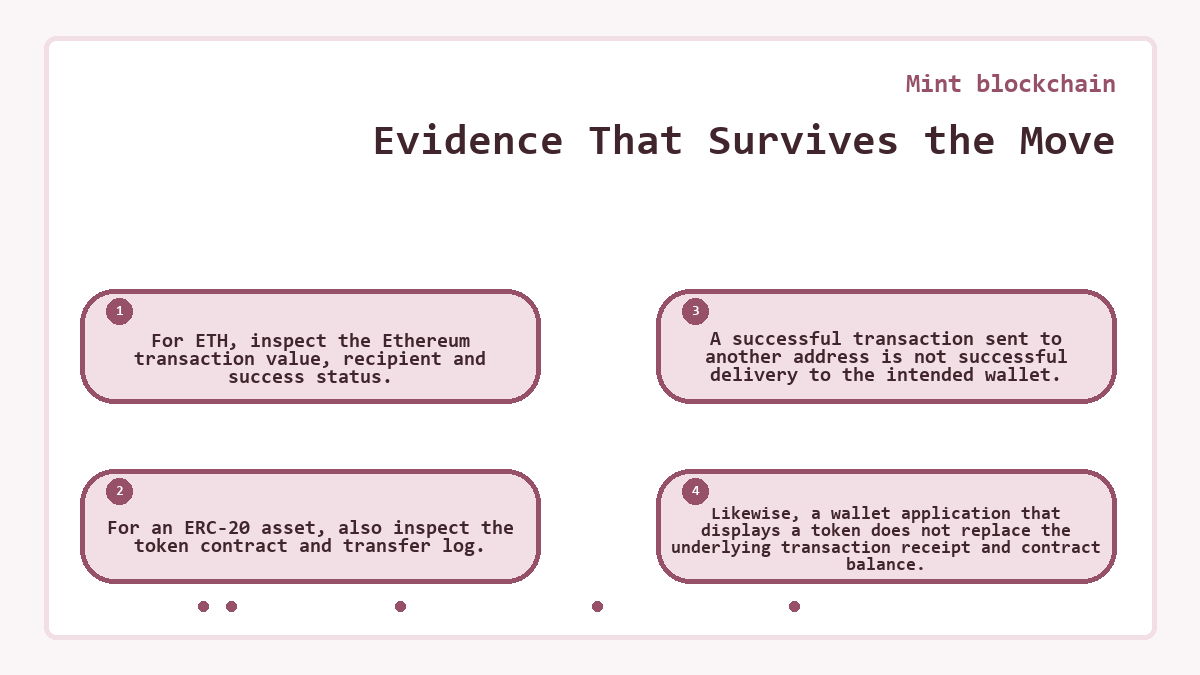
For ETH, inspect the Ethereum transaction value, recipient and success status. For an ERC-20 asset, also inspect the token contract and transfer log. A successful transaction sent to another address is not successful delivery to the intended wallet. Likewise, a wallet application that displays a token does not replace the underlying transaction receipt and contract balance.
Keep full addresses and exact transaction hashes rather than cropped fragments. These identifiers persist after a browser session ends and allow the request, transfer and destination to be distinguished. Never store a seed phrase or private key with the case records; neither is needed to identify a withdrawal.
How Long Can a Mint Withdrawal Take?
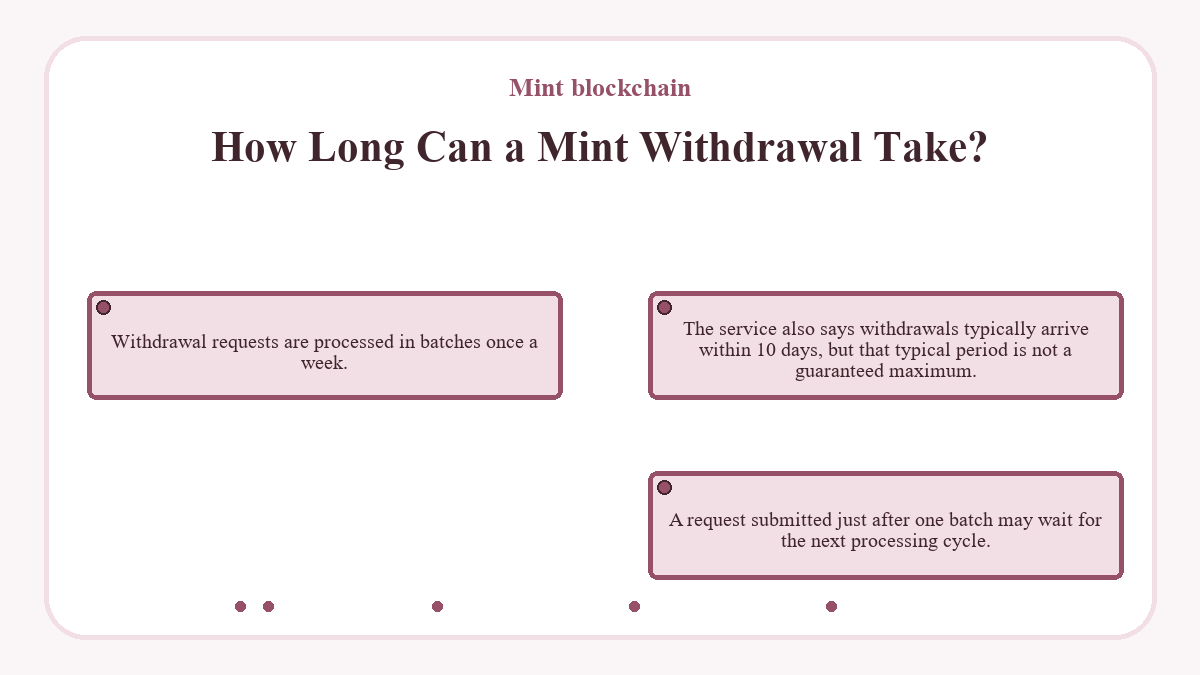
Withdrawal requests are processed in batches once a week. The service also says withdrawals typically arrive within 10 days, but that typical period is not a guaranteed maximum. A request submitted just after one batch may wait for the next processing cycle.
Batch waiting and Ethereum confirmation are different states. Before an Ethereum transaction appears, the request remains within the service’s processing path. Once a transaction is available, its receipt and destination provide the relevant delivery evidence. A wallet interface may refresh later, so display timing should not replace the onchain result.
The shutdown notice requires users to complete withdrawals before October 20, 2026. The published material does not say that an earlier submission extends processing past the cutoff. Since 10 days is a typical arrival period rather than a promise, the final days before the cutoff provide no documented timing buffer.
A request still within the stated typical window can be monitored using its existing evidence. If no Ethereum delivery appears after that period, preserve the original request details and use the service contact. No published material says that a duplicate request accelerates a batch, and a duplicate could make the unresolved state harder to trace.
Destination Control After Delivery
Control of the receiving address determines who can use a completed Ethereum balance. The service describes delivery to an Ethereum wallet. With self-custody, the holder of the wallet’s private key or approved signing arrangement controls subsequent transfers.
A later transfer to a custodial deposit address changes that relationship. The custodian controls the keys and decides whether its account system credits a particular token contract. An Ethereum transaction can succeed while the custodial account remains uncredited, so confirm that the custodian accepts the exact asset before making that later transfer.
The same hexadecimal address format can appear on Mint and Ethereum because both use the Ethereum Virtual Machine address model. Network context still matters. After withdrawal, inspect the Ethereum transaction and Ethereum balance rather than relying on the former Mint position.
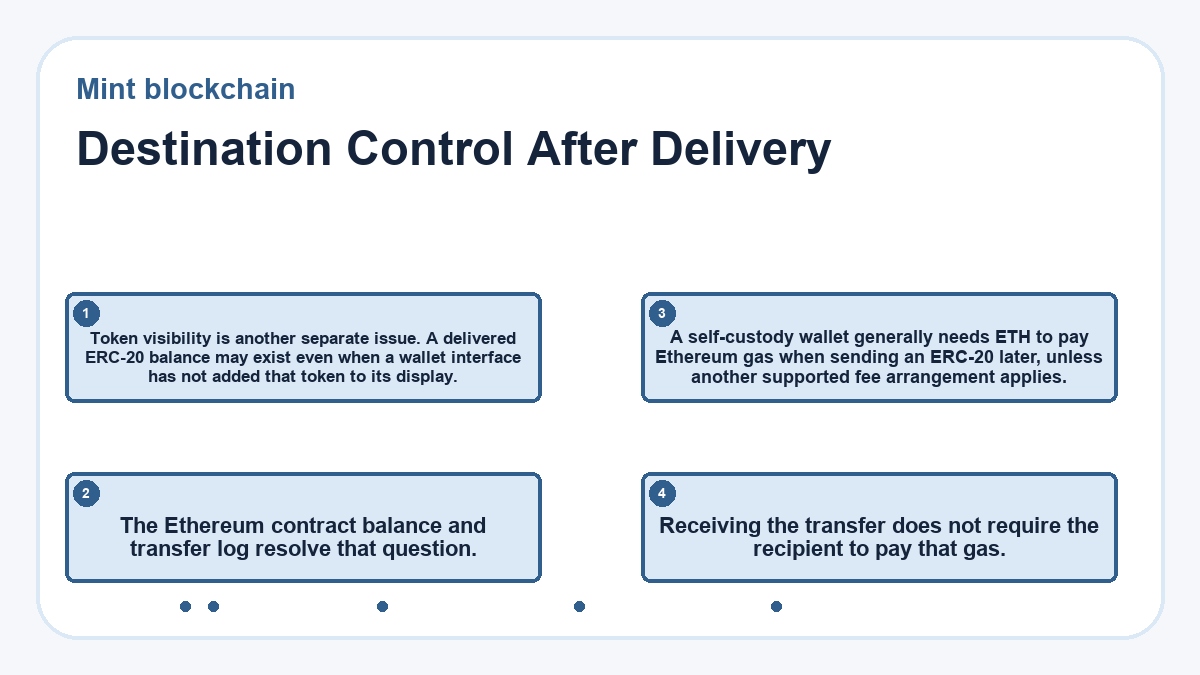
Token visibility is another separate issue. A delivered ERC-20 balance may exist even when a wallet interface has not added that token to its display. The Ethereum contract balance and transfer log resolve that question. A self-custody wallet generally needs ETH to pay Ethereum gas when sending an ERC-20 later, unless another supported fee arrangement applies. Receiving the transfer does not require the recipient to pay that gas.
Stop Conditions Before the Cutoff
A pre-submission stop is appropriate when the asset is not listed, the connected address is wrong or the displayed amount differs from the intended balance. Correcting uncertainty before commitment preserves the option to leave without authorizing a transfer.
A post-submission wait is appropriate while one recorded request remains inside the typical processing period and no conflicting transaction appears. Preserve its state rather than replacing it. The absence of public cancellation instructions means that a duplicate should not be treated as an edit.
A completed state requires a successful Ethereum transaction tied to the intended recipient and asset. If the transaction failed, identifies another recipient or records a transfer from a different token contract, stop treating the request as finished. Save that evidence for the existing support path.
The cutoff ends the published withdrawal process for balances left on Mint. A verified Ethereum receipt closes the task; a submitted form, pending label or Mint-side transaction does not. Reaching that evidence before October 20, 2026 is therefore the boundary between a completed exit and an unresolved position.
Mint blockchain: frequently asked questions
Does Submitting a Request Before October 20, 2026 Guarantee an on-time Exit?
No. The published instruction is to withdraw before October 20, 2026, while the service processes weekly batches and describes arrival within 10 days as typical. That period is neither a guarantee nor a fixed maximum. Treat successful Ethereum delivery as the completed state and allow processing time before the cutoff instead of relying on submission alone.
Can a Mint Withdrawal Request Be Changed or Canceled After Submission?
The public withdrawal page does not describe an editing or cancellation mechanism. Treat submission as the point where the connected wallet, asset and amount must already be correct. If the interface shows an unresolved request, preserve its identifier and status rather than sending a replacement. Any correction should follow case-specific instructions from the service contact.
Is a Submitted Request Proof That Assets Reached Ethereum?
No. Submission shows that a request entered the processing path, not that an Ethereum transfer succeeded. Completion evidence includes an Ethereum transaction hash, a successful receipt, the intended recipient and the correct asset amount. For WBTC, USDC or USDT, the token contract and transfer log also matter because a ticker displayed by a wallet is not sufficient identification.
How Are Weekly Batches Different From Ethereum Confirmations?
A weekly batch determines when the withdrawal service processes queued requests. Ethereum confirmation begins only after a transaction has been submitted to Ethereum. Before that transaction exists, additional Ethereum blocks cannot advance the request. Once it appears, the receipt and recipient balance show whether delivery succeeded, while the original batch status remains supporting evidence rather than the final result.
Where Can I See the Cost of a Mint Exit?
No fixed withdrawal fee is published on the public withdrawal page. Record any fee, deduction or net amount that the connected interface presents before submission, but do not infer a zero cost from the absence of a public schedule. After delivery, compare the requested amount with the Ethereum transfer evidence and use the actual transaction data rather than a cached estimate.
Can the Withdrawal Portal Move the MINT Token to Ethereum?
The published portal does not list MINT as an eligible withdrawal asset. Its displayed set is limited to ETH, WBTC, USDC and USDT. A MINT balance should not be relabeled or submitted as one of those assets. Preserve the wallet and balance evidence, then use the service contact for any asset that falls outside the published set.
Why Might a Delivered Token Remain Invisible in My Ethereum Wallet?
A wallet application may not automatically display every ERC-20 token, even when the address holds a balance. Check the Ethereum transaction status, recipient, transfer log and token contract from the actual delivery. If those details match, the issue may be token display rather than settlement. Do not add a contract address taken from an unrelated search result or message.
What Records Help If a Withdrawal Needs Investigation?
Useful records identify one request without exposing wallet secrets. Keep the connected address, asset and amount, submission time, any request identifier or error text and the Ethereum transaction hash if one exists. Full addresses and hashes are more useful than cropped screenshots. Never provide a seed phrase, private key or unsolicited signature because none is required to identify the transaction history.